

Filter media degradation of pollutants
Overview
In a Koi pond pollutants such as ammonia develop, which must be removed because of its toxic effect on the water.
This can be achieved by filtration of the water.In contrast to the mechanical filtration for the removal of the
solid state, the dissolved toxins can be removed by the
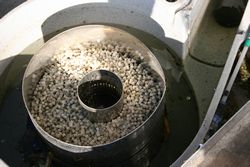 bio-filter removed. The bacteria are doing this work. They are situated on special filter media,
which has a very large surface. Due to the large surface a sufficient number of bacteria can be guaranteed.
Frequently used filter media are the Japan mat and Kaldnes.
bio-filter removed. The bacteria are doing this work. They are situated on special filter media,
which has a very large surface. Due to the large surface a sufficient number of bacteria can be guaranteed.
Frequently used filter media are the Japan mat and Kaldnes.
Further Information
In a Koi pond ammonium is produced by decomposition of proteins. The coinciding base, ammonia, is a highly toxic neurotoxin.
The toxic effect is deadly even at low concentrations. In nature, these toxins effectively decomposited by a bio-chemical
process using bacteria and through an intermediate step converted from nitrite to the rather non-toxic nitrate. This process
of biological treatment must be made in a Koi pond on a small scale.
Thus a place for colonization has to be created in a Koi pond. The bacteria that do the transformation are already in the
water of the pond, but not in sufficient degree to relieve the water from toxic substances. Therefore a medium or a
combination of different media will be provided that the bacteria in the bio-filter have sufficient place for colonization.
Two main factors come into effect.
Surface:
By providing one, corresponding to the volume, very large surface area through the filter medium a large
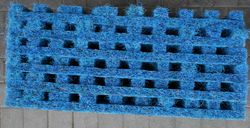 number of bacteria can be located on a relatively small area. The Japan mat uses this effect. It consists of a sturdy
plastic mesh. The surface is approximately 275 square meters per cubic meter of mat. This means that a cube with edge
length of 1 meter has a population of 275 square meters of surface or an area of approximately 16.5 x 16.5 meters.
The water flows through the mats, the toxins are decomposed by bacteria. Crucial to the functioning of the mats Japan
is a preliminary cleaning of the water where solids are removed by filters.
number of bacteria can be located on a relatively small area. The Japan mat uses this effect. It consists of a sturdy
plastic mesh. The surface is approximately 275 square meters per cubic meter of mat. This means that a cube with edge
length of 1 meter has a population of 275 square meters of surface or an area of approximately 16.5 x 16.5 meters.
The water flows through the mats, the toxins are decomposed by bacteria. Crucial to the functioning of the mats Japan
is a preliminary cleaning of the water where solids are removed by filters.
Special design:
A sophisticated design ensures sufficient space for colonization, but also for several other properties, which increase
the filter function. E.g. Kaldnes is build wheel-shaped with spokes, which circulate by their buoyancy through the water.
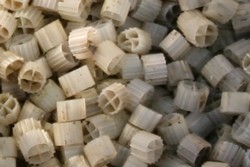 The on the outside located bacteria are removed mechanically. Younger bacteria with a faster metabolism can settle there.
In the sheltered indoor the bacteria, live their natural cycle, free from mechanical effects, which is beneficial to
the entire process of Nitrification. Kaldnes has a surface of up to 800 m2.
The on the outside located bacteria are removed mechanically. Younger bacteria with a faster metabolism can settle there.
In the sheltered indoor the bacteria, live their natural cycle, free from mechanical effects, which is beneficial to
the entire process of Nitrification. Kaldnes has a surface of up to 800 m2.
On the surface of the filter media a layer of live and dead bacteria and other microorganisms will be built, called bio film. This layer has the property to gather agents and to subsequently and convert them, when they are not immediately decomposed. If there is insufficient pre-cleaning, the filter media, after some time has to be cleaned of solids, this at least partially, causes the destruction of the bio film. Until the construction of a new equivalent bio film only a reduced filter performance can be expected. The best filter effect is achieved through a combination of several filter media.

